KSMmodel.ai Launches Executive Education Program for Universities, Consultants & Enterprises
Eight-week applied program brings the Knowledge Structuring Model (KSM) into universities, consulting firms and
Press Release Disclaimer: This is a press release distributed through the XPR Media network. It has not been independently verified by our newsroom.
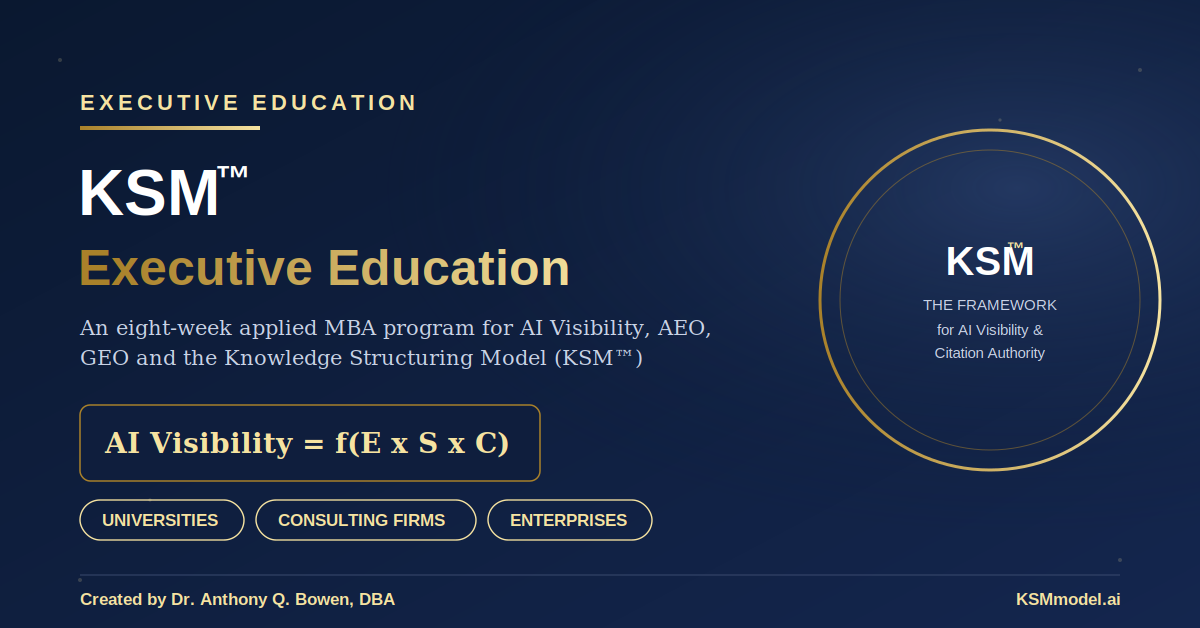

Eight-week applied program brings the Knowledge Structuring Model (KSM) into universities, consulting firms and enterprises
NEW YORK, NY, UNITED STATES, September 16, 2026 /EINPresswire.com/ — KSMmodel.ai, the home of the Knowledge Structuring Model (KSM), founded by Dr. Anthony Q. Bowen, announced the launch of the KSM Executive Education Program, an eight-week applied MBA and executive education program for executives, consultants, graduate students and cross-functional leaders developing practical strategies for AI Visibility and enterprise knowledge readiness.
The program, AI Visibility and Enterprise Knowledge Strategy – AEO, GEO and the Knowledge Structuring Model (KSM), is built on the published Knowledge Structuring Model created by Dr. Bowen and is aligned with his book, AI Visibility, AEO and GEO: Understanding the Knowledge Structuring Model.
As artificial intelligence increasingly shapes how organizations are discovered, interpreted, trusted, recommended and cited, leaders face the challenge of translating AI Visibility from an emerging marketing concept into coordinated enterprise action.
“Organizations do not need another collection of AI Visibility, AEO and GEO buzzwords,” said Dr. Anthony Q. Bowen, creator of KSM. “They need leaders who understand content, technology, identity, authority, governance and measurement work together. This program gives executives and consultants a structured way to diagnose the problem, establish ownership and build a practical roadmap for action.”
The program is built around three pillars: Extractable Structured Content, which ensures organizational knowledge can be retrieved and interpreted by AI systems; Entity Salience, which establishes clear, consistent relationships among organizations, leaders, products, services and locations; and Citation Authority, which strengthens the evidence, provenance and third-party validation that support organizational credibility. KSM expresses these relationships through the framework AI Visibility = f(E x S x C).
Participants move through four stages: Understand, Diagnose, Design and Execute. Across eight modules, participants examine the AI Visibility economy, apply the KSM framework, assess structured content, evaluate entity and knowledge graph alignment, examine citation authority, establish governance and delivery models, develop measurement approaches and build an executive-level 90-day implementation roadmap. The program concludes with an Executive Capstone in which participants present an integrated AI Visibility strategy to an executive or client audience. Participants work toward an executive-ready strategy and a 90-day roadmap rather than a certificate of completion.
“The objective is not simply to teach people what AEO, GEO or AI Visibility mean,” Dr. Bowen said. “The objective is to give leaders the ability to determine what is wrong, what needs to change, who owns the work, how it should be governed and what should happen during the first 90 days.”
The program has been designed for three audiences. Universities can bring the program into MBA and graduate-level education through curriculum licensing, faculty enablement, textbook alignment, applied capstone work and LMS-ready delivery options. Consulting firms can use the program to educate consultants and establish a shared KSM methodology for AI Visibility advisory work, including client assessment methodology and pathways to implementation support. Enterprises can deploy private cohorts for executives and cross-functional teams working against real organizational challenges, applying KSM across marketing, technology, content, communications, data, legal, AI and governance functions to develop a prioritized 90-day roadmap with defined ownership and measures.
Organizations completing the program can determine whether subsequent implementation should be handled internally, through consulting partners, through a hybrid model or through KSM-aligned implementation partners. Education and implementation remain distinct: the program develops the strategy, governance and decision-making capability required to direct the work, while implementation and remediation engagements are scoped separately.
The program is grounded in Dr. Bowen’s research on AI Visibility, Answer Engine Optimization, Generative Engine Optimization, the Knowledge Structuring Model and Enterprise Knowledge Readiness for Agentic AI, published on SSRN. KSM was developed as a socio-technical framework explaining how organizations can improve their ability to be interpreted and cited by AI systems through stronger knowledge structure, entity clarity and authority signals.
Universities, consulting firms and enterprises interested in curriculum licensing, practice enablement, private cohorts or organizational delivery can request program information at https://ksmmodel.ai/executive-education. Additional information about the Knowledge Structuring Model is available at https://ksmmodel.ai.
Dr. Anthony Q. Bowen is the creator of the Knowledge Structuring Model, a corporate AI strategist, professor, researcher and author working at the intersection of AI Visibility, enterprise knowledge strategy, marketing, technology and organizational transformation. His work focuses on helping organizations move from document-centric digital strategies toward structured, entity-centric knowledge environments capable of supporting AI-mediated discovery and emerging agentic AI systems.
Dr Elinor Garely
KSMModel.ai
+1 2126824499
email us here
Legal Disclaimer:
EIN Presswire provides this news content “as is” without warranty of any kind. We do not accept any responsibility or liability
for the accuracy, content, images, videos, licenses, completeness, legality, or reliability of the information contained in this
article. If you have any complaints or copyright issues related to this article, kindly contact the author above.

Media gallery