
Six Republican-Led States Redraw Congressional Maps Post-Supreme Court Ruling
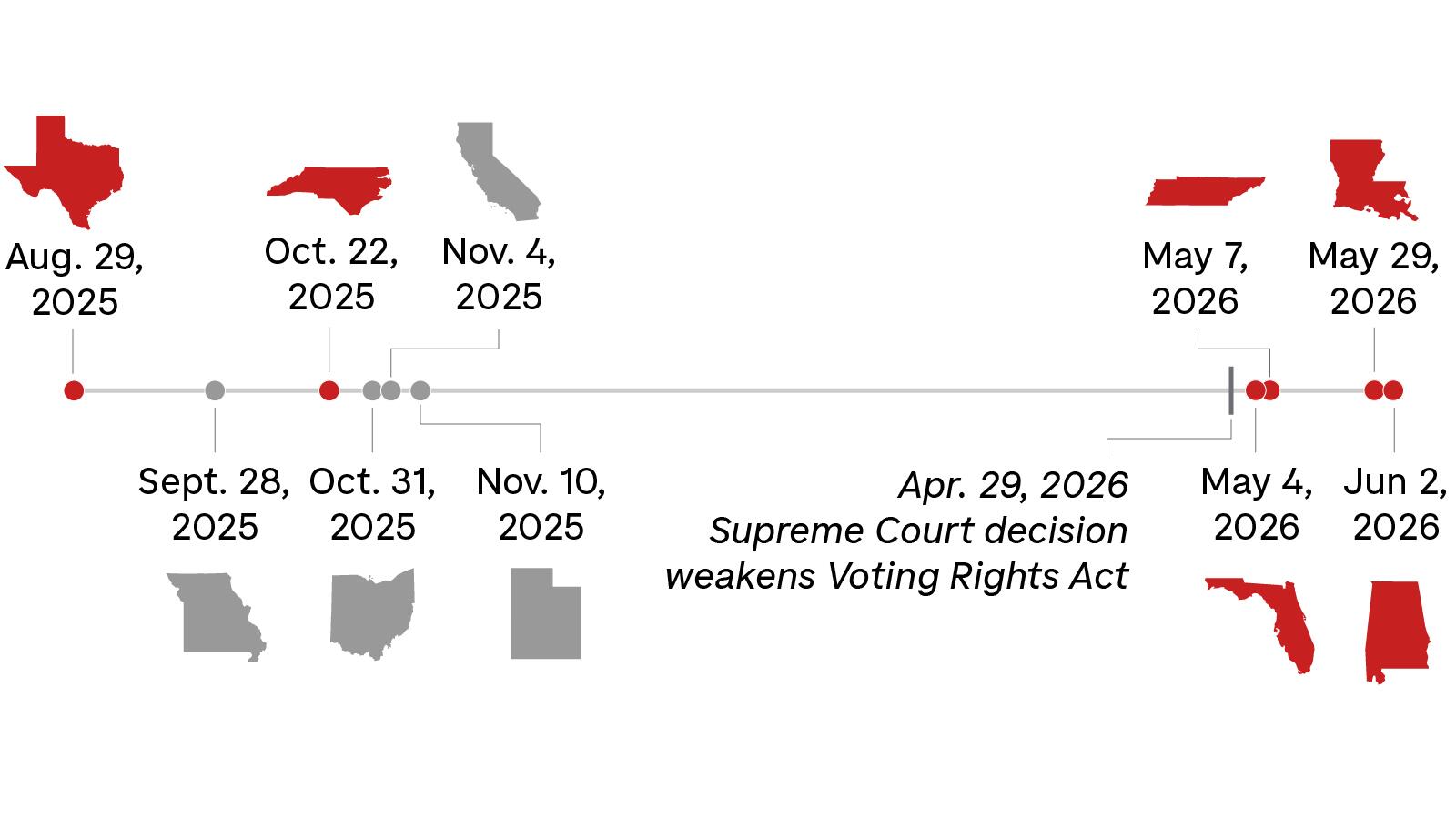
Following a U.S. Supreme Court decision that weakened the Voting Rights Act, six Republican-led states (Texas, Florida, Louisiana, Alabama, Tennessee, and North Carolina) have redrawn congressional maps. These changes have predominantly affected majority-Black and plurality-Black districts by splitting Black communities…
 Nashville, TN, July 30, 2026 —
In the wake of a significant U.S. Supreme Court decision that altered the landscape of voting rights protections, six states led by Republican lawmakers have undertaken the redrawing of their congressional district maps. The affected states include Texas, Florida, Louisiana, Alabama, Tennessee, and North Carolina.
These redistricting efforts have primarily impacted congressional districts that are either majority-Black or have a plurality of Black voters. Reports indicate that these new maps have, in several instances, split existing Black communities. These communities have then been absorbed into predominantly white electoral districts.
The consequence of these map revisions has been a notable impact on Democratic representation in these states. By altering the composition of districts that previously held significant Black populations, the new boundaries appear to dilute the voting power of these communities, often to the benefit of Republican candidates and the detriment of Democratic incumbents or prospective candidates.
The Supreme Court’s decision, which has been cited as a catalyst for these state-level redistricting actions, is understood to have weakened the Voting Rights Act. This weakening has provided states with more latitude in how they draw district lines, potentially diminishing the federal oversight designed to prevent racial discrimination in voting.
The specific details of the redrawn maps and their exact electoral consequences are continuing to unfold. The changes reflect a broader political and legal struggle over voting access and representation across the United States, particularly concerning minority communities.
Story summarized from the original created by Tony Gonzalez on wpln.org, see more information here.
Media gallery